Understanding the Yuga Cycle in Hinduism
The concept of the Yuga Cycle is one of the most fascinating teachings in Hindu philosophy. It represents the eternal and cyclical nature of time, showing how human civilization evolves spiritually, morally, and intellectually across different ages. Unlike the modern belief that time moves only in a straight line, Hinduism views time as a continuous cycle of creation, preservation, decline, and renewal.
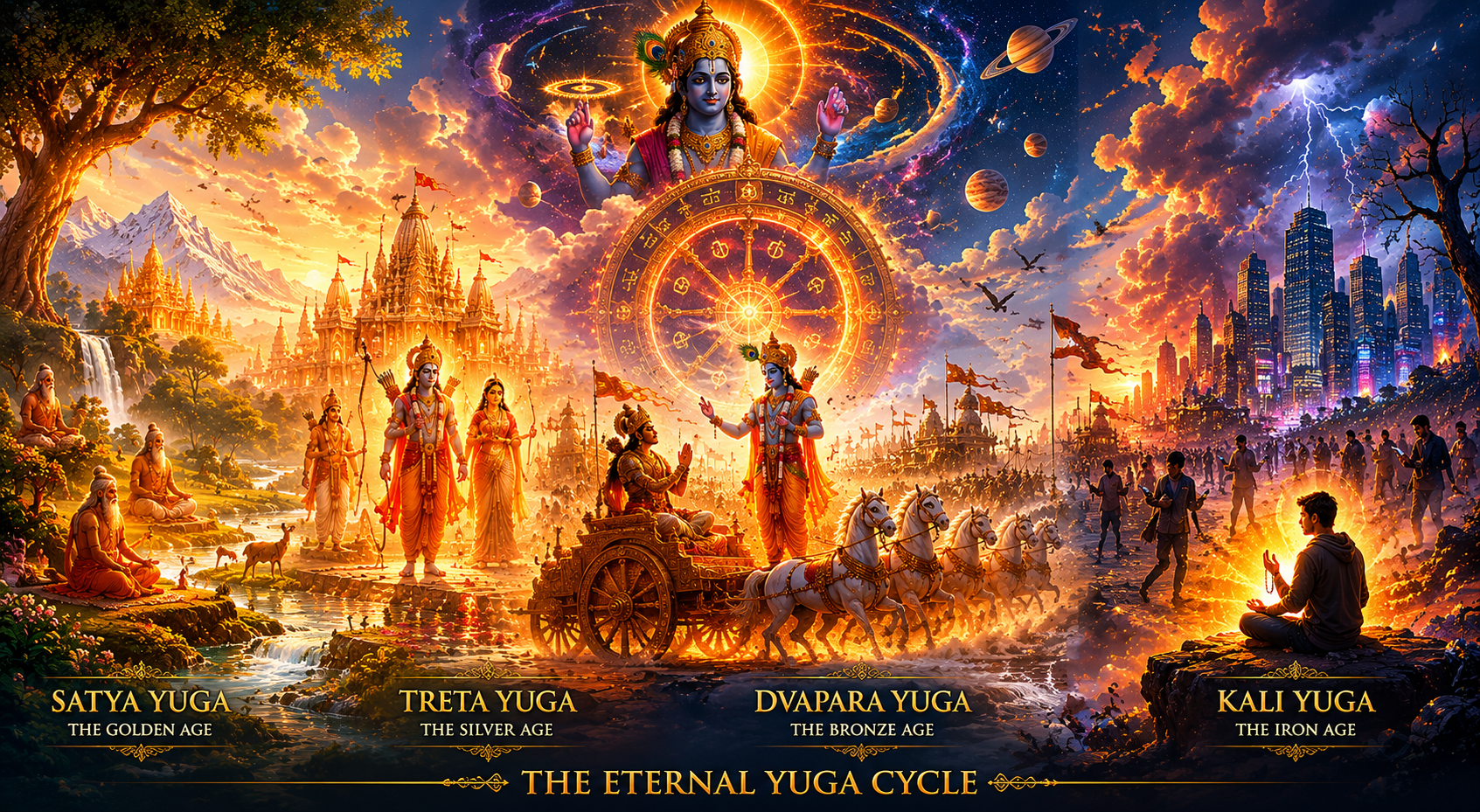
According to ancient Hindu scriptures, time is divided into four great ages known as the Yugas:
- Satya Yuga – The Golden Age
- Treta Yuga – The Silver Age
- Dvapara Yuga – The Bronze Age
- Kali Yuga – The Iron Age
These Yugas occur in a repeating cycle, similar to the changing seasons or the waxing and waning phases of the moon. Each Yuga reflects the spiritual and moral condition of humanity during that era.
The Four Yugas Explained
1. Satya Yuga – The Golden Age
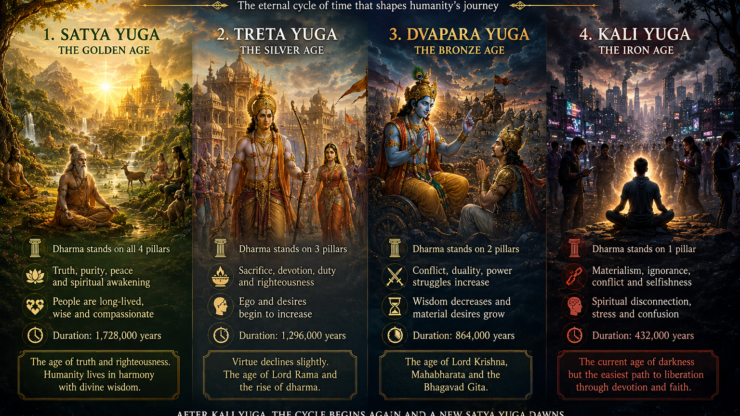
Satya Yuga is considered the age of truth, purity, and righteousness. During this period, humanity lives in harmony with divine principles. People possess high spiritual consciousness, wisdom, compassion, and inner peace. Dharma (righteousness) stands firmly on all four pillars.
- Duration: 1,728,000 years
- Characteristics: Truth, enlightenment, peace, spiritual awakening
2. Treta Yuga – The Silver Age
In Treta Yuga, virtue begins to decline slightly. Dharma stands on three pillars instead of four. Although spirituality remains strong, human desires and ego gradually begin to increase.
This is the age associated with sacred events such as the story of Lord Rama described in the Ramayana.
- Duration: 1,296,000 years
- Characteristics: Sacrifice, devotion, duty, emergence of ego
3. Dvapara Yuga – The Bronze Age
Dvapara Yuga marks a further decline in spiritual values and wisdom. Dharma remains on only two pillars. Conflicts, divisions, and material desires become more common.
This age is closely connected with Lord Krishna and the events of the Mahabharata and the Bhagavad Gita.
- Duration: 864,000 years
- Characteristics: Conflict, duality, reduced spirituality, rise of power struggles
4. Kali Yuga – The Iron Age
Kali Yuga is the current age in which humanity is believed to be living today. It is known as the age of darkness, confusion, materialism, and spiritual decline. Dharma stands on only one pillar.
Despite its challenges, Hindu scriptures also teach that Kali Yuga offers the simplest path to spiritual liberation through devotion, chanting God’s name, meditation, and sincere faith.
- Duration: 432,000 years
- Characteristics: Materialism, ignorance, conflict, spiritual disconnection
The Ratio of the Yugas
The durations of the four Yugas follow the sacred ratio of:
4 : 3 : 2 : 1
This means that each successive Yuga becomes shorter and spiritually weaker than the previous one. According to the Srimad Bhagavatam, the durations are:
| Yuga | Duration |
|---|---|
| Satya Yuga | 1,728,000 years |
| Treta Yuga | 1,296,000 years |
| Dvapara Yuga | 864,000 years |
| Kali Yuga | 432,000 years |
Together, these four Yugas form one complete cycle known as a Mahayuga.
The Deeper Meaning of the Yuga Cycle
The Yuga Cycle is not merely about measuring time; it symbolizes the spiritual journey of humanity. As each age progresses, there is a gradual decline in:
- Wisdom
- Morality
- Knowledge
- Spiritual awareness
- Human lifespan and strength
However, the cycle never ends permanently. After Kali Yuga reaches its conclusion, the cycle resets, and a new Satya Yuga begins bringing renewal, purity, and spiritual awakening once again.
This eternal cycle reminds us that darkness is temporary, and truth ultimately returns.
Spiritual Significance in Modern Times
Understanding the Yuga Cycle helps us reflect on the current state of the world and our individual spiritual paths. Even in challenging times, Hinduism teaches that personal transformation, devotion, and self-realization remain possible.
The purpose of spiritual practice is not to fear Kali Yuga, but to rise above negativity through:
- Meditation
- Bhakti (devotion)
- Self-discipline
- Good karma
- Study of sacred scriptures
By reconnecting with divine wisdom, humanity can move closer to inner peace and enlightenment.